
Generasi Hijau, how many times do you spend traveling in a year? Maybe more than 5 times. Traveling is a good choice to take a break from our routines. A decade of the rise of social media have changed and boosted the tourism sector. In 2019, around 10,4% of world gross domestic product comes from the tourism industry. While in Indonesia it contributes 6,1% of gross domestic product. Tourism is very important for world economic growth. However, sometimes we are not concerned about the environmental damage impact of tourism.
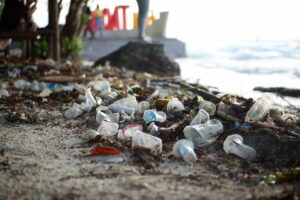
As a reliable sector, the tourism industry potentially brings huge carbon footprints. The tourism industry contributes to 8% of world emissions. One of many factors that generates emission in the tourism sector is food waste that worsens global warming through greenhouse gasses. In Indonesia, based on the study of the Indonesian Ministry of Environment and Forestry (Indonesia: Kementerian Lingkungan Hidup dan Kehutanan / KLHK) and Student Association for Environmental and Adventure Activity in 2016, they figure out 453 tonnes of waste was found in 8 Indonesian mount national parks. The waste produced by the tourism activity of 150.688 visitors. Every visitor can produce 3 Kg of waste each day. Mostly the waste found is plastic waste amounting to 250 million tonnes (53%). Moreover, remember that there were 50 tonnes of waste found on some beaches in Bali such as Kuta, Legian, Seminyak, and Jimbaran by the end of 2021.
Indonesian Sustainable Tourism
Indonesian waste problem phenomena issue a new concept of tourism management called “Sustainable Tourism”. This is a concept of tourism that prioritizes the benefits of the environment, social, culture, and economy. It was appointed by the Indonesian Ministry of Tourism and Creative Economy in the Minister of Travel’s Decree No. 14/2016. One of the characteristics of this concept is the application of CHSE (Cleanliness, Health, Safety, Environment sustainability). It is a certification for the tourism industry that applied CHSE standards in tourism activity.
Tourist Behaviours

To implement sustainable tourism, all aspects in this industry have to take roles. The tourist, tourism industry player, community, and governments have their own roles and are supposed to be balanced.
Now, a lot of Indonesian tourists do not understand the importance of understanding environmental sustainability in tourism. They break rules to put trash in the trash bin. Therefore, waste scatters in the destination and is inconvenient.
Cleverdon categorized tourist behaviors into 5 categories based on the level of tourists’ interest in the environment. Those are Lounger, User, Eco-aware, and Special Ecotourist. Mostly, Indonesian tourists were categorized as Loungers since the tourism activity is only aimed for recreation without environmental knowledge and curiosity. To implement sustainable tourism, at least they have to level up into eco-aware and start to be aware of environmental sustainability in their tourism activity. They also have curiosity in environmental sustainability knowledge.
Travel Business Behavior
Tourism businesses’ role is realized in the application of CHSE standards in business activity. Now, Indonesia has 11.986 tourism businesses that have CHSE certification in 34 provinces and 403 districts or cities. Various tourism businesses such as hotels, diving, golf, white water rafting, restaurants, event organizers, tourism attractions, and creative economy can get this certification. There are some requirements to acquire this certification. For the environmental aspect, the actors have to use eco-friendly equipment, use water and energy efficiently, manage waste completely, healthily, and eco-friendly, and also monitor and evaluate the application of CHSE. <br><br>Not only to fulfill the standard of CHSE, but the actors also have to educate the tourist in applying eco-friendly lifestyle in tourism activity periodically. They can provide eco-tourism guides, engage the tourist to join conservation activities, and strictly prohibit littering.
The Role of the Government In Sustainable Tourism

As the controller of sustainable tourism implementation, the government has substantial responsibility and role to escort tourists and industry actors in realizing sustainable tourism. The government has 3 main roles as mediator, facilitator, and legislator.
As a mediator, they connect collaborative initiatives of tourists, tourism businesses, and communities in realizing sustainable tourism together. Not only connecting, they also have to facilitate collaborative initiatives by providing qualified waste management facilities and infrastructures to elevate CHSE application. One more important role is to create a policy which is in line with the existing problems, therefore, it will be an exact solution. They also have to apply the policy firmly and disciplined.
EcoRanger in Indonesian Tourism

In line with all parties’ efforts to implement sustainable tourism, EcoRanger presents a community-based waste management solution to preserve the environment of Indonesian tourism destinations, both National Tourism Strategic Areas (KSPN) and non-strategic ones.<br><br>Commemorating HPSN 2022, EcoRanger invited the fishermen of Pancer Village in Banyuwangi to fish for litter in the ocean. This is a Fishing For Litter Project collaboration of Greeneration Foundation and GIZ Indonesia as part of Rethinking Plastics: Solution to Marine Litter. Besides working with the fisherman, EcoRanger also works with the tourists and local community in monthly Beach Cleanup. For Road to HPSN 2022, EcoRanger held a Beach Cleanup on February 5th, 2022 that was also joined by Andien Aisyah, one of the Indonesian top singers. Collaboration with a public figure boosts public interest in protecting nature from waste. This action was attended by 20 volunteers who collected 11.5 Kg waste and planted 15 Australian pine successfully.<br><br>Moreover, EcoRanger also educates the villagers around Pulau Merah Beach about waste management routinely. It aims to encourage the villagers to sort waste from home. EcoRanger also manages the villagers’ waste in the Waste Management Center (Indonesian: Sentra Kelola Sampah / SEKOLA) together with the Banyuwangi Environment Agency and recycling industry. Since June 2019 up until now, EcoRanger has managed more than 611 tonnes of waste. These actions were held from 2018 to realize sustainable tourism in Banyuwangi progressively.
Beyond Banyuwangi, EcoRanger expands the impact to National Tourism Strategic Areas (KSPN). EcoRanger presents in Bilebante Green Tourism Village, Lombok. Commemorating HPSN 2022 in February 21st, EcoRanger and Aksi Indonesia Lestari Foundation (Ddorocare) held cleanup around the Green Tourism Village and Madrasah (MI/MTs/MA) Hadil Ishlah empowering the students. Around 206 students joined the action and collected 67.2 Kg of waste successfully. The waste collected will be processed in Indonesia Lestari Waste Management Center (B-SILe). This initiative will be done to develop sustainable waste management in Bilebante Village. This action series is supported by the New Zealand International Development Cooperation Programme.

Previous variety solutions of waste management in tourism destinations have to encourage individual initiative actions. Not only applying 3R in solving this complicated waste problem, but also we have to apply 9R (Rethink, Refuse, Reduce, Recycle, Reuse, Replace, Replant, Refill, and Repair). We apply this principle to be more aware of the cause and effect of not eco-friendly tourism activity. It helps us to prevent environmentally destructive behavior in tourism.