
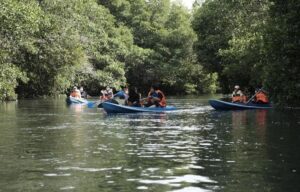
Recently, mangrove forest has become a trendy tourism destination for local and international tourists. They visit the forest with different aims. Some of them enjoy the scenery and take pictures. While others learn about mangrove ecosystems and conservation. Indonesia has a lot of mangrove tourism destinations. These are recommended destinations for you: Bedul Mangrove Forest in Banyuwangi, Taman Wisata Alam Angke Kapuk, Kulonprogo and Tarakan Mangrove Forest, to name a few. Rangers, have you ever visited a mangrove forest? Let’s find facts about mangrove tourism in Indonesia!
Mangrove Forest

Mangrove Forest (Unsplash / Waranont Joe)A mangrove forest is a forest consisting of individual mangrove trees that grow in a colony on the sea coast and river estuary. This dicot plant can live in brackish water, the meeting point of seawater and fresh rivers. Most of the mangroves grow well in sloppy soil such as Rhizopora mucronata and Avicennia marina.
Mangrove forests have abundant benefits for humans and the environment. This forest is the main fortress of sea abrasion to prevent the coast from being crushed by the waves. In addition, mangrove forests are also a habitat and breeding ground for various coastal ecosystem biotas such as small fish and shrimp. Mangrove trunks can be used as firewood. Mangrove forests also have an important role to absorb CO2 generated from human activities. The existence of mangrove forests reduces the potential of CO2 which has a negative impact on climate change released into the atmosphere. The amount of carbon absorbed by these forests provides benefits from the blue carbon produced by mangroves.
The Potential of the Indonesian Mangrove Forest

Mangrove Planting In Setokok Beach (Laily Rachev / BPMI Setpres)Indonesia is the largest country with mangrove forests in the world. We have 8.8 million hectares of mangrove forest. This is home to 202 species of mangrove plants. The 43 species are true mangroves (Noor et al. 1999). This area must be managed and protected properly to prevent exploitation and destruction.
However, currently, 1.7 hectares of it have been damaged. Land conversion, development of aquaculture, and the uncontrolled use of mangrove wood as firewood cause the damage. It impacts world climate change.
Mangrove Forest Ecotourism

Mangrove forest destruction can reach 51 million hectares annually. It must be preserved through conservation. The tourism sector can also play a role in supporting forest conservation by implementing ecotourism. Of course, ecotourism development must prioritize environmental sustainability.
Ecotourism is a responsible tourism development concept for the preservation of nature and local wisdom. So, ecotourism development must prioritize environmental conservation, environmental education, and sustainable community empowerment. This concept first entered Indonesia in the 1980s. The first ecotourism activities offered were mountain climbing and Lake Toba’s visit. Ecotourism has been regulated in the Minister of Home Affairs Regulation Number 33 of 2009.
The use of this forest as ecotourism is like a double-edged sword. It can have a good impact on empowering the surrounding community and the environment if managed properly. However, if it is mismanaged, it will definitely harm nature and the surrounding community. Mismanagement can arise from the ambition to reap the maximum financial benefits.
We have to start a rigid implementation of ecotourism principles by providing education on mangrove conservation for tourists, responsible waste management facilities, empowering local communities as tourism managers, regulating the number of tourist visits, maintaining the original landscapes, carrying out mangrove rehabilitation regularly, and applying local wisdom in tourism management.
As visitors, we must also be responsible for preserving this forest, Rangers! Stay on an eco-friendly and zero-waste lifestyle in preventing burdens on the community and the environment. You can also participate in mangrove rehabilitation activities such as planting mangroves with other tourists. Let’s visit the mangrove forest to support sustainable tourism!