
Lombok, West Nusa Tenggara (Indonesian: NTB) is a popular tourism destination becomes one of 5 super priority national tourism destinations (Indonesian: KSPN). This is good news for tourism and economic sector because tourism supports Lombok’s economic growth. Despite Covid-19 affecting this sector, 1 million tourists still visited Lombok in 2021. In 2022, the government targets the number of tourists to increase to 1.5 million people. Therefore, is there any correlation between tourism development and waste management?
Unfortunately, tourism and economic growth are lagging behind the capacity for sustainable waste management. While the tourism sector places additional burden on local waste management, NTB already generates 3.388 tonnes of waste every day. Ironically, 80% of it is unmanaged.
In response to this problem, EcoRanger conducted research on TPS 3R Bonjeruk Asri waste generating. It aims to figure out the reason behind the low level of 3R TPS waste processing by integrating 5 aspects of waste management (Operational, regulation, community participation, funding, and institutional). Therefore, it will support the implementation of responsible waste management.
TPS 3R Bonjeruk Asri

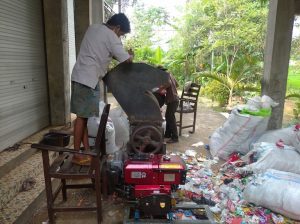
TPS 3R is an abbreviation for Tempat Pemilahan Sampah Reduce Reuse Recycle. This term indicates a waste processing facility with a relatively comprehensive recycling infrastructure: waste shredding machines and composters. TPS 3R Bonjeruk Asri is located in Bonjeruk Village, Central Lombok and was established in November 2021. They focus on managing waste generated by villagers. The Bonjeruk Village Head Decree 16 of 2021 regulates the operation of the TPS 3R. This waste management center provides some facilities such as triseda (motor tricycle), sorting table, shredder, and sacks.
Every month, the villagers can produce 12-13 tonnes of waste. Approximately 41.78% of it is organic and 1.4% is inorganic. Residual waste is the largest production for about 56.8% (TPS 3R Bonjeruk Research, EcoRanger, 2022). The highest percentage of residual waste occurs because the TPS 3R is only able to recycle 2.5 tonnes of waste per month.
In collecting waste, They apply 3R (Reuse, Reduce, Recycle) principle to process it. They recycle organic waste into compost and inorganic waste in the recycling industry. The Agency Environmental Service transfers residual waste to the waste processing center.
In running the operation, they need funding. They generate this funding from customer retribution and recycling income. The biggest income comes from customer retribution around 77.18%. Meanwhile, recycling income only contributes to 22.82%. The TPS 3R customers are entrepreneurs, tour operators, and individuals. The cost for individuals is IDR 15.000 and for entrepreneurs is IDR 35.000.
Besides managing waste, they also take a role as educators. They educate the villagers about managing waste through mutual assistance (gotong royong), socialization, and village programs. Those activities are beneficial for the villagers to learn.
Community Behavior in Waste Management

The community behaviors in managing waste need to be improved. A reason why unmanaged waste percentage is high is because of lack of knowledge in waste management. Of 10.272 villagers, only 110 listed as TPS 3R customers. It means that the rest of them do not manage their waste well yet.
Based on the survey result that involved 75 villagers, 54% of respondents don’t know where their waste ends up. So far, most of them still burn the waste (65%) and dispose their waste into landfills and drains (21%). This is a big mission for Bonjeruk Village to create a more relevant and impactful education curriculum for community behavioral change.
Optimizing TPS 3R Waste Management Potential

The research reveals many points that need to be improved to increase the waste processing rate. Here, EcoRanger recommends some solutions in 5 waste management aspects.
Firstly, for the operational aspect, the TPS 3R should replan business processes and workload to streamline the operation. Moreover, waste processing equipment and personal protective equipment (PPE) need to be completed and rejuvenated. The workers also need capacity building about waste management tools operation to utilize all facilities they have.
Secondly, they need to improve regulation. Many villagers are not informed about the Bojeruk Village Head Decree that rules waste management. Then, the TPS 3R does not have a Standard Operational Procedure (SOP), which influences the ineffectiveness of the work system. They have to form an SOP to create a regular work system. The village government has to play a role by issuing village regulations to rule waste processing procedures.
Thirdly, the internal aspect that needs optimization is funding. They need to identify and train business models to map business potential and networks. Furthermore, TPS 3R can also open opportunities for external funding through proposals. To support funding, they need to increase the branding to maintain public trust.
Fourthly, the institutional aspect Summarizes those three aspects. Currently, the management of TPS 3R consists of the chairperson, administration, operations, education, and media divisions. Unstructured institutional management becomes an obstacle. Therefore, it is important to improve the quality of human resources in managing institutions in order to build a structured system, regulation, and multi-stakeholder cooperation.
The Importance of Multi-stakeholder and Community Collaboration

In conclusion, the community involvement itself has to be optimized to help waste management at the 3R TPS. TPS 3R must provide them with relevant, creative, and various facilities and learning activities. The strategies offered are door-to-door education, TPS 3R visits, festivals, group discussions on Whatsapp, and educational calendars.
TPS 3R Bonjeruk Asri supported by local stakeholders and EcoRanger will follow up on recommendations from this research.