
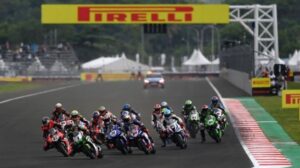
The prime MotoGP in Mandalika was held on March 18th – 20th, 2022 in Pertamina Mandalika International Street Circuit, Lombok, West Nusa Tenggara. Indonesia felt honored to become a host of international motorcycle racing, MotoGP for the first time in 24 years. MotoGP in Mandalika was won by Miguel Oliveira in the 1st podium, Fabio Quartararo in 2nd podium, and Johann Zarco in 3rd podium as the winners of 1000cc class. Even though it was held during the pandemic, 63.000 spectators attended this event, even Joko Widodo as the president of the Republic of Indonesia. Exactly, this was an excellent opportunity for the local government to recover the economy impacted by Covid-19 through sports tourism. According to Indonesia Tourism Development Corporation (ITDC), approximately the income received through MotoGP would achieve more than 500 billion rupiahs, which was obtained from tickets selling, transportations, culinaries, merchandises, accommodations, and sponsors.

MotoGP was held firstly in 2000, however, it was pioneered by the Grand Prix since 1949. After that, the event name changed to MotoGP. MotoGP was held by Federation Internationale de Motocyclisme (FIM). In its establishment, this competition has held races for 125cc, 250cc, 350cc, and 500cc classes. Not only the racer but also the automotive companies such as Ducati, Yamaha, Honda, Red Bull, etc have been competing to create motorcycles with sophisticated technology. The domination of Italian and Japanese companies creates intense competition.
MotoGP Carbon Footprint

From An environmental sustainability perspective, we figure out some environmental impacts and problems on MotoGP enforcement. This event has a responsibility to the carbon footprint they produced in all activities. It potentially produces a carbon footprint through the development of motorcycle technology, the use of fossil fuels, and the heap of waste generated by each game.
Specifically discussing the use of fuel, MotoGP has a certain standard of fuel used. They use fuel with octane level on RON 95-102 to avoid lead. In every race, they use an enormous amount of 22 Liters of fuel! The fossil fuels used in MotoGP also produce a carbon footprint of greenhouse gas emissions like our usual motorcycles.
Every year, motorcycles produce 4,6 metric tonnes of carbon dioxide emissions. A full petrol tank of a motorcycle can produce 8.887 grams of CO2. If a motorcycle produces 251 grams of CO2 per km, the racer’s motorcycle can produce higher CO2 emissions since they use more petrol and the distance could reach 130 km. Counting the estimation of carbon footprint, over 500cc racers can produce 0,03 metric tonnes of CO2 in 120 Km.
Besides CO2, other greenhouse gasses such as methane and nitrous oxide are also produced by the gasoline-burning process. Although the amount is less than CO2, the substance is enough to exacerbate global warming. Especially methane gas which is very dangerous for environmental sustainability.
The solution of A Sustainable Race

Conceiving that MotoGP also contributes to greenhouse gas emissions through the use of fossil fuel, the promoter established MotoGP’s sustainable concept. They will reduce the use of fossil fuel in 2024 by roughly 40% and will reach free fossil fuel in 2027. To achieve those aims, they will develop innovation and research to find the most efficient alternative energy to replace fossil fuels. Despite not finding the alternative yet, they keep running the laboratory to find the best and most sustainable renewable energy. They collaborate with world-class petrol companies and experts to find out the alternative.
The innovation of renewable energy hopefully can also be used for other vehicles. It may be a big innovation in the future of low or free emission renewable energy. This is the moment of sport to consider the sustainability of the environment in its activities. The sustainability aspect of sport also supports sustainable tourism.